Do you need a permit to clear land in St. Lucie County?
Often, yes. In unincorporated St. Lucie County, removing native vegetation can require a Vegetation Removal Permit from the county’s Environmental Resources Department. Inside Port St. Lucie, the city protects trees 12 inches in diameter and larger, and removing one takes a $35 permit. Brush-level clearing is treated differently, but checking first is always the move.
This is the piece of land clearing people skip, and it is the piece that turns a one-day job into a months-long headache when it goes wrong. Here is how the local rules actually break down, straight from the county and city sources.
Who regulates clearing around here?
Two layers, depending on where the property sits:
| Authority | What it covers | Where to apply |
|---|---|---|
| St. Lucie County ERD | Vegetation Removal Permits, land clearing guidelines, unincorporated county | County’s online permitting portal (Tyler EnerGov) |
| City of Port St. Lucie Planning & Zoning | Protected trees: 12”+ diameter, native palms with 10 ft clear trunk | Tree Removal Permit application, $35 fee |
| City of Fort Pierce | City code and clearing rules inside city limits | City permitting and code offices |
The county side runs through the Environmental Resources Department, which publishes its own land clearing guidelines and processes everything through an online portal. The city side is about trees specifically, under an ordinance Port St. Lucie adopted in 2011 to protect mature canopy.
What trees does Port St. Lucie protect?
Any tree measuring 12 inches or more in diameter at breast height, and native palms with at least 10 feet of clear trunk, on public or private property. Removing one requires a Tree Removal Permit from Planning and Zoning, with a written reason and a tree survey in the application packet.
There is a big exemption that matters to most homeowners: platted single-family lots are exempt from the tree preservation requirements as long as minimum landscaping requirements are met and maintained. Non-native fruit trees like mango, avocado and citrus are also exempt. So a typical PSL homeowner clearing overgrowth on a platted lot is usually not in ordinance territory at all, while acreage and pre-development clearing very much can be.
What happens if you skip the permit?
The city spells it out: removing a protected tree without a permit can bring a citation, mandatory replacement at a 3-to-1 ratio, and double the normal application fee, with each tree counting as a separate violation. On the county side, the ERD’s own FAQ includes a section titled “What should I do if I already removed vegetation,” which tells you how often this happens after the fact.
None of that is worth it. The permit costs less than a tank of diesel, and the penalty math runs against you fast on a lot with multiple mature trees.
Does mulching underbrush need the same permits?
Understory clearing sits in different territory than protected-tree removal. Most of what a mulching machine eats is palmetto, Brazilian pepper, vine and brush, and pepper is not something any Florida authority wants preserved. The state lists it as a prohibited invasive, which we covered in our Brazilian pepper guide.
That said, county rules on native vegetation can still apply depending on the parcel, its zoning and what is growing. We do not pretend to be the permitting office, and neither should anyone quoting your job. The reliable process is one call with your parcel number before the machine mobilizes: county ERD for unincorporated land, Planning and Zoning inside the city. Confirm what your specific parcel needs, in writing when it matters.
How does this work when you hire us?
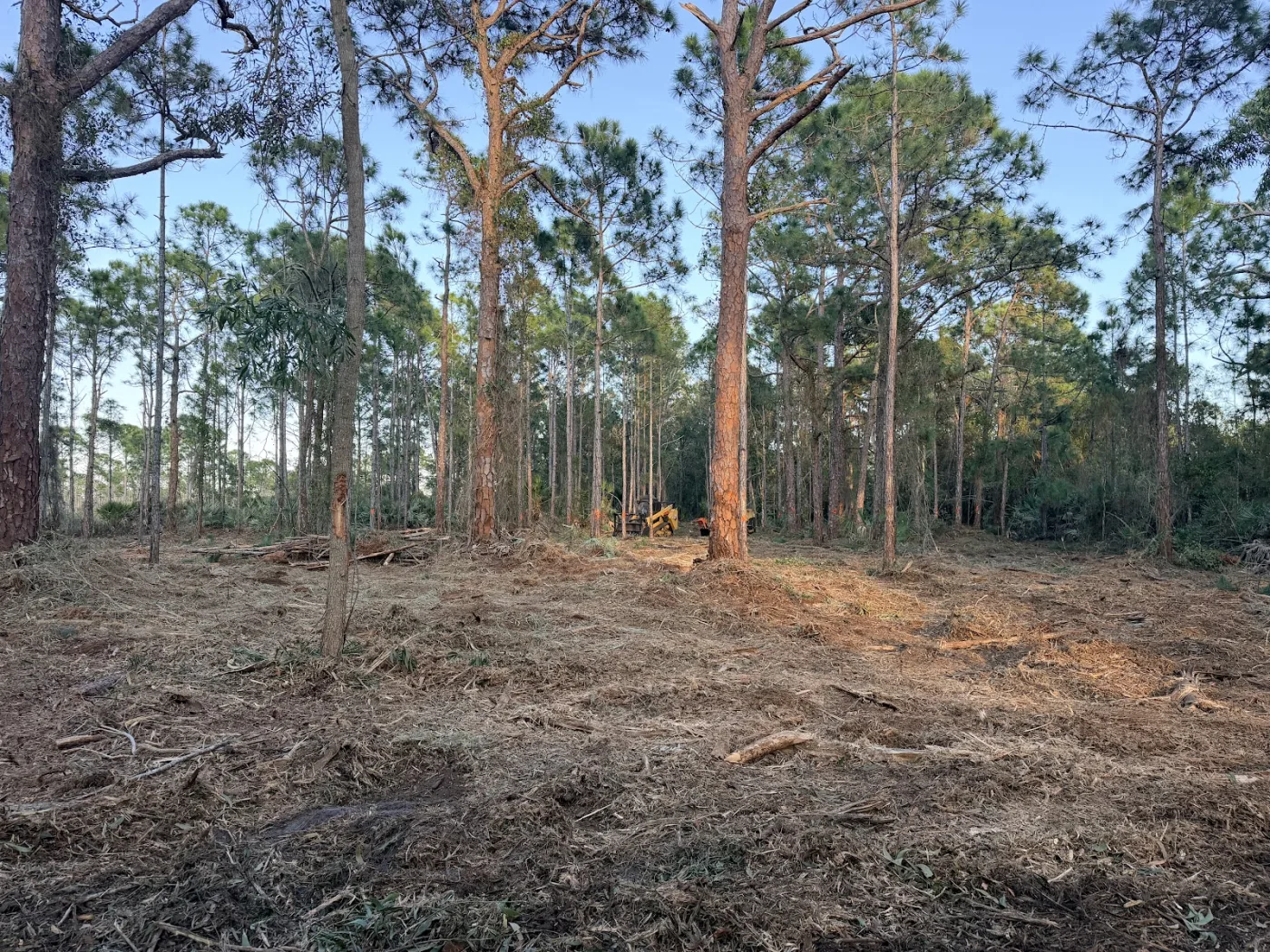
We flag it on the walk-through. When we look at a property for forestry mulching or a lot clearing, part of the conversation is what is growing, what stays, and whether anything on the plan touches permit territory, like mature trees on unplatted acreage. Keeper trees get flagged and worked around. Questions about a specific parcel get answered by the office that owns the answer, before work starts, not after.
If you have a property and a plan and want to know what it takes, call or text (561) 308-9776. The look and the estimate are free, and we would rather spend ten minutes on permits up front than watch an owner learn the 3-to-1 replacement rule the hard way.